
When shopping for furniture, kitchen cabinets, wardrobes, or TV units in India, many people get confused between Engineered Wood and Particle Board. While Particle Board is actually a type of Engineered Wood, they are often compared as different options due to their varying quality and price. This simple guide will help you understand the real difference and choose the right material for your Delhi, Mumbai, Bangalore, or any Indian home.
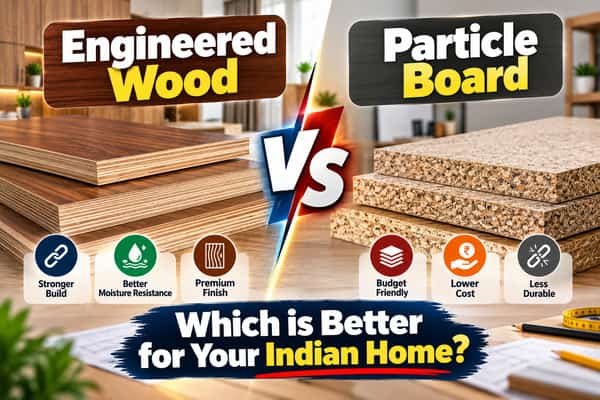
What is Engineered Wood?
Engineered Wood is a broad category of man-made wood panels. It includes MDF (Medium Density Fiberboard), HDF, Block Board, and Particle Board. These are made by breaking wood into fibers or particles, mixing with resin, and pressing under high heat. They are then finished with laminate, veneer, or acrylic. Engineered wood is widely used because it is consistent and affordable.
What is Particle Board?
Particle Board (also called chipboard) is the lowest grade of engineered wood. It is made by mixing small wood chips and sawdust with resin and pressing them into sheets. It is the cheapest option available in the market. Popular brands in India include Action Tesa, Greenlam, Century, and local options.
Head-to-Head Comparison
Strength & Durability
- Engineered Wood (especially MDF): Much stronger and denser. It holds screws better and can handle moderate weight without sagging easily.
- Particle Board: Weakest among engineered options. It bends and breaks easily under heavy load. Not suitable for large shelves or heavy furniture.
Cost
- Particle Board: Cheapest option. Furniture made from it is very budget-friendly.
- Engineered Wood (MDF/HDF): 30–70% more expensive than particle board but still cheaper than plywood. Offers better value in the long run.
Moisture Resistance
This is crucial for Indian homes.
- Engineered Wood (MDF): Better moisture resistance if you choose moisture-resistant (MR) grade. Still needs good edge sealing.
- Particle Board: Very poor. It swells, becomes soft, and loses shape quickly when exposed to water or high humidity. Common problem during monsoons in Delhi and Mumbai.
Weight
- Both are lightweight compared to solid wood or plywood, making them easy to move.
- Particle Board is the lightest but also the most fragile.
Surface Finish & Looks
- MDF (Engineered Wood): Very smooth surface, perfect for painting, membrane, or laminate finish. Gives a premium look.
- Particle Board: Rougher surface with visible chips. Needs thicker laminate to hide imperfections.
Termite Resistance
Both need anti-termite treatment. Engineered wood (MDF) generally performs slightly better if pre-treated.
Lifespan
- Engineered Wood (MDF): 10–18 years with good care.
- Particle Board: 5–10 years. It degrades faster in Indian climate.
Application
- Engineered Wood: Wardrobes, TV units, pooja units, light cabinets, and decorative furniture.
- Particle Board: Low-budget temporary furniture, packing, or hidden areas where strength is not important.
Which One Should You Choose?
Choose Engineered Wood (MDF/HDF) if:
- You want better strength and longer life.
- For visible furniture in living rooms and bedrooms.
- Moderate budget with good quality expectation.
- Using in areas with occasional humidity.
Choose Particle Board if:
- Very tight budget (rental homes, temporary setups).
- For non-structural or hidden parts.
- Light-use items like small storage boxes.
Smart Indian Tip: Never use plain Particle Board in kitchens or bathrooms. For Indian homes, always go for Moisture Resistant (MR) MDF with thick laminate or veneer on all sides. Many carpenters use a hybrid method — better quality Engineered Wood for the carcass and Particle Board only for internal shelves to save cost.
Environmental & Health Angle
Both use wood waste, making them eco-friendly compared to solid wood. Always choose E0 or E1 grade (low formaldehyde emission) boards, especially important for families with children and elderly. Look for ISI mark and Green certification.
Frequently Asked Questions (FAQ)
Q1. Which is better – Engineered Wood or Particle Board?
A. Engineered Wood (especially MDF) is much better in strength, durability, and moisture resistance. Particle Board is only good for very low-budget needs.
Q2. Is Particle Board the same as Engineered Wood?
A. Particle Board is one type of Engineered Wood. MDF is a higher quality engineered wood.
Q3. Which is better for Indian kitchen?
A. MDF (Engineered Wood) with proper sealing is better. Never use regular Particle Board in kitchens.
Q4. Does Particle Board swell in monsoon?
A. Yes, very easily. It can get damaged within days if water touches the edges.
Q5. What is the price difference?
A. Particle Board furniture is 30–70% cheaper than MDF-based engineered wood.
Q6. Which one is lighter?
A. Both are light, but Particle Board is lighter and weaker.
Q7. Best brands in India?
A.
- Action Tesa (good for both)
- Greenlam
- Century Ply (for better quality MDF)
- Archidply
Q8. Can I paint directly on these?
A. MDF gives better painting results. Particle Board needs extra primer and care.
Final Verdict
Engineered Wood (MDF) is clearly the better choice for most Indian families. It offers good strength, smooth finish, and decent durability at an affordable price. Particle Board should only be used when budget is extremely tight and the furniture will face very light use.
For the best results, always go for MR grade boards and ensure all edges are properly sealed with laminate or PVC edging. Visit showrooms in your city (Kirti Nagar in Delhi has many options), check the material thickness, and discuss your usage with the designer.
Remember, your furniture has to survive Indian family life — festivals, kids playing, and humid weather. Investing a little more in better Engineered Wood (MDF) usually saves money in the long run by reducing repairs and replacements.